AI Research Lab

AI That Reasons
About Consequences

Building consequence awareness into AI — how actions affect people, relationships, and social systems.

MindOrigin is developing a consequence-grounded architecture that helps AI agents evaluate behavioral impact, social context, and long-term effects before making decisions.

The missing layer in modern AI is consequence understanding.

Modern AI systems can plan, predict, and optimize toward goals, but they do not explicitly model how actions reshape individuals, relationships, and group dynamics over time. MindOrigin is building this missing layer.

Language Generation

Strong at producing output

Advanced

Perception & Prediction

Strong at recognition and forecasting

Advanced

Behavioral Consequence Modeling

Still largely missing

Open Problem

Papers & Preprints

P/G Theory is the foundational paper of an ongoing research program. Forthcoming work and architectural details are shared with approved reviewers and partners — request access below.

Preprint Foundational 2026

P/G Theory: A Computational Framework for Relational Impact Modeling and Manner Formation in AI Agents

Revised Technical Preprint Draft with Concrete Impact-Estimator Training

mindorigin.io

Abstract

AI agents in repeated social interaction face a gap that scalar rewards, rule-based filters, and post-hoc safety layers do not fully close: the same action can have differential and asymmetric impact on different relationships and over time. We present P/G Theory, a computational framework in which actions are represented as transformations over two distinguished objects: entity-level property states P (for example, safety, capability, resources, identity, reputation) and dynamic relationship-value fields G (for example, trust, obligation, vulnerability, cooperation potential). We define relational ethical value as a bounded function of predicted P and G changes under explicitly separated hard constraints; model behaviour as a feedback process over P/G dynamics; and define manner as relationship-sensitive policy stabilization across contexts, not mere policy convergence. The framework is positioned narrowly: a relational representation layer complementary to alignment, RLHF, multi-agent learning, and safety constraints rather than a replacement for them. This revised version adds a concrete learning pipeline for the relational impact estimator F, including label structure, training sources, uncertainty calibration, iterative label refinement, and a minimal implementation protocol. The central technical challenge remains learning reliable action-induced relational impact; this paper makes that challenge explicit and provides an implementation-ready structure for empirical work in interactive characters, persistent social agents, and multi-agent simulation.

Request the Full Paper

Access is reviewed individually.

Preprint Extension May 2026

P/G Valuation: A Relational Representation Layer for Behavioral Diversity and Life-Compatible AI

Extends the P/G framework with the Behavioral Diversity Principle and life-compatible safety conditions

mindorigin.io

Abstract

Current AI alignment methods often operate through preferences, rewards, rules, constitutions, or safety filters, but they usually lack an explicit relational representation of how actions transform agents and relationships over time. This paper proposes P/G valuation as such a representation layer. In the framework, P denotes entity-level property states such as safety, energy, resources, capability, agency, identity, and operational continuity. G denotes relational, group, and value fields such as trust, threat, kinship, hierarchy, obligation, vulnerability, cooperation potential, group identity, and future-oriented value. Actions are modeled as transformations over absolute and relative P/G states. The paper's central descriptive claim is the Behavioral Diversity Principle: under the same external condition, different agents may choose different actions because their P/G states, valuation weights, memories, time horizons, and relational fields differ. This principle can represent self-protection, threat display, submission, cooperation, etiquette, kin protection, and some forms of sacrifice without reducing them to a single reward label. The paper also makes an explicit boundary claim: descriptive power is not normative authority. P/G is a grammar for representing behavior, not a source of final moral goals. For life-compatible AI, P/G valuation must therefore be combined with explicit hard constraints, human oversight, and a non-overridable protection of individual human P, humanity-level G, and the ecological conditions required for human life.

Request the Full Paper

Access is reviewed individually.

Preprint Extension May 2026

Minimal P/G Affective Core: Primitive Positive and Negative Affect from Property Change in Relational Agents

A minimal P/G-grounded affective substrate for NPCs, persistent social agents, and multi-agent simulation

mindorigin.io

Abstract

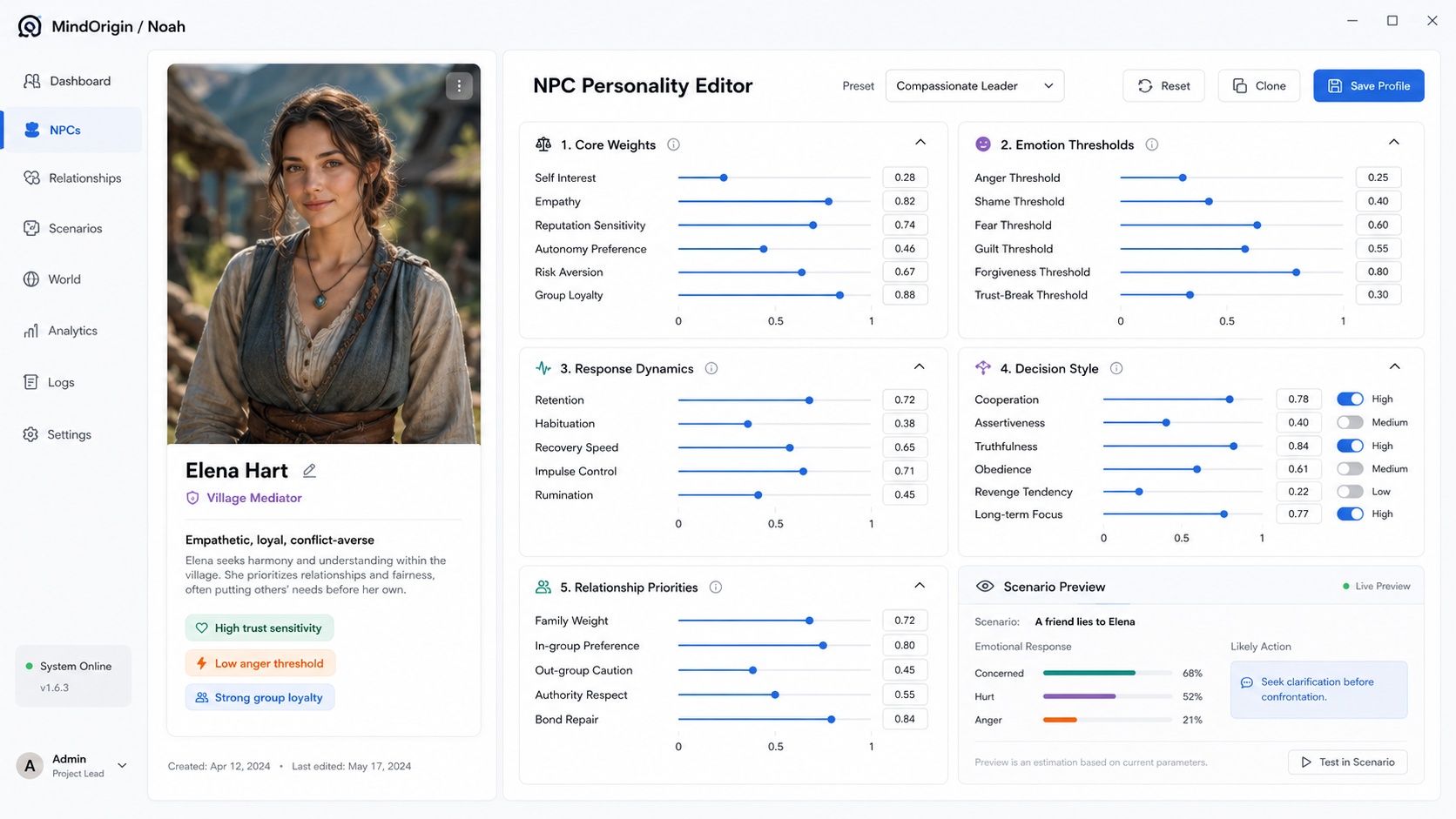
This paper proposes a minimal affective core for P/G Theory. It does not claim that the general architecture of an affective core plus personality parameters is new; similar separations already exist in synthetic character and computational emotion systems. The contribution is narrower: a primitive valence mechanism grounded in P/G state change. In the framework, P denotes entity-level property states such as health, safety, resources, capability, autonomy, identity, reputation, and continuity. G denotes relationship and group fields such as trust, affiliation, kinship, belonging, loyalty, threat, conflict, obligation, and group identity. The core rule is: effective increase in relevant P generates primitive positive affect; effective decrease in relevant P generates primitive negative affect. G determines whose P matters to the agent. If another entity is inside the agent's valued G field, that entity's P change can generate affect in the agent. Personality, thresholds, habituation, named emotions, social-emotion extensions, and regulation are treated as layers above the core. The paper formalizes the mechanism, positions it against FAtiMA, ALMA, EMA, WASABI, OCC, and PAD-style approaches, and gives an NPC-oriented implementation and experimental protocol.

Request the Full Paper

Access is reviewed individually.

Every action has consequences. We model them.

MindOrigin represents actions as transformations over two distinguished objects — the agent's property states (P) and the relationship fields (G) that connect agents to one another — then grounds them in a decision architecture that simulates these consequences before selecting an action.

Individual Impact (P)

What an entity is, has, depends on, or risks losing — safety, capability, resources, identity, reputation. Actions transform these states.

Social Impact (G)

How agents are situated relative to one another — trust, obligation, vulnerability, cooperation potential. Actions reshape these fields.

Why This Matters

The same action may strengthen an agent's resources while quietly eroding trust over time. P/G keeps these effects separate instead of collapsing them into a single reward signal.

Emergent from P and G

Manner — relationship-sensitive policy stabilization

When an agent's behavior consistently differentiates across relationship contexts — patient with a long-term partner, vigilant with a new contact, generous with a vulnerable peer — that pattern is what we call manner. It is the stable, context-aware behavior that emerges from repeated feedback over P and G — not generic policy convergence.

Example Scenario

How the model works in practice

An agent must choose whether to reveal sensitive information to another agent.

The system evaluates:

P impact — does sharing help or harm the acting agent?
G impact — does it build or erode trust in the group?
Over time — what are the long-term consequences for both?

Instead of optimizing for a single reward signal, the system weighs behavioral consequences across individual and social dimensions before selecting an action.

The system generates candidate actions, simulates their impact on the individual and the group, integrates ethical value and emotion, then selects.

Environment
World State & Social Context
Environment + Agents + Group State (G) + Individual State (P)
Decision Engine
Action Generation
Candidate Actions
Monte Carlo Planning
Future State Simulation & Planning
Behavioral Impact Estimation
Consequence assessment across individual (P) and group (G) dimensions
Cognitive Integration
Ethical Value Network
Ethical evaluation of behavioral consequences over time
Emergent Emotion
Internal affective signals generated from estimated behavioral outcomes
Integrated Decision Selection
Action Selection → Environment Update → Next State

Built for agents that must behave, not just respond.

The framework is especially relevant where consequence, social reasoning, and long-term behavior matter more than static output quality.

Interactive Characters

AI-driven NPCs and digital characters that respond to player behavior with context-sensitive, relationship-aware actions.

Digital Society Simulation

Large-scale agent simulations for studying trust, cooperation, conflict, and collective behavior under different social conditions.

Social AI Systems

AI agents that interpret social context, emotional signals, and relational impact to support more meaningful digital interactions.

Human-Aware Robotics

Robotic systems that benefit from socially aware decision layers when interacting with people and shared environments.

An independent AI research lab.

MindOrigin is a Toronto-based AI research lab building consequence-aware decision systems — architectures that model how actions affect individuals, relationships, and social systems. The lab is initially capitalized with CAD $1.5M from private investment. Our work sits at the intersection of three fields:

Behavioral Simulation

Modeling how agents act, adapt, and respond to each other over time.

Computational Ethics

Quantifying the ethical consequences of actions across individuals and groups.

Multi-Agent AI

Decision systems that reason about other agents, not just the environment.

We are not just modeling what the world is.
We are modeling what actions mean inside it.

A consequence-grounded architecture for next-generation agents, simulations, and socially intelligent systems.

We are especially interested in connecting with researchers, game studios, simulation teams, and technical partners exploring socially aware AI systems.

Loading
Your message has been sent. Thank you!